
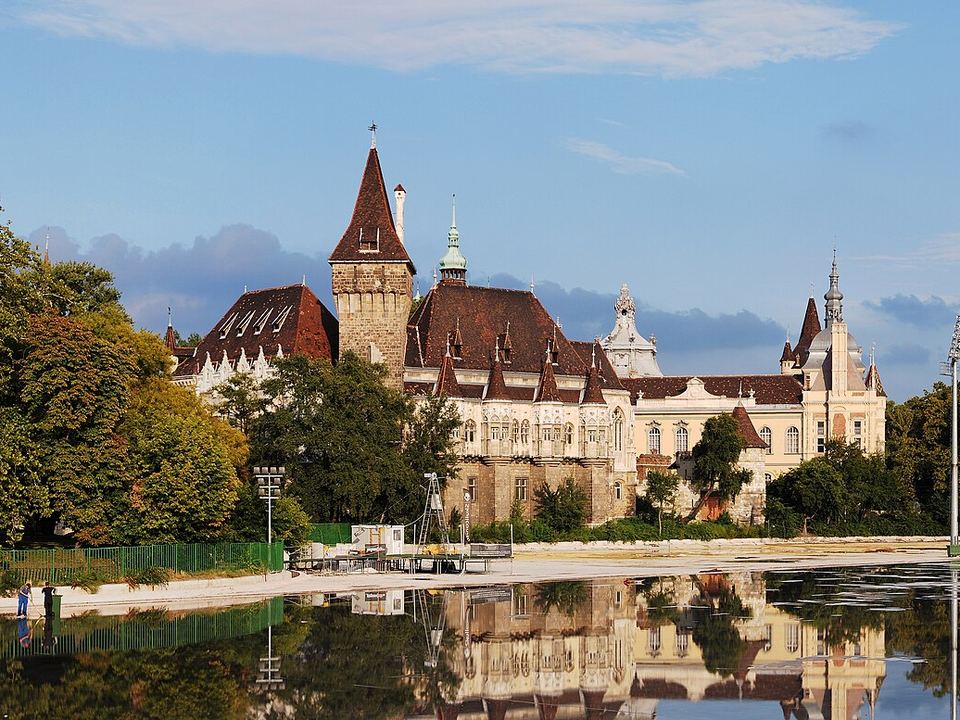
Vajdahunyad Castle
- Museum
- Architecture & Design Landmark
- Price: 0 Ft - 2 400 Ft
- Opening hours: Grounds open 24h; Museum of Agriculture 10:00 - 17:00 (closed Mon)
History
Vajdahunyad Castle began life as a stage prop. For Hungary's 1896 Millennial Exhibition, marking a thousand years since the Magyar tribes settled the Carpathian Basin, architect Ignác Alpár was asked to design a pavilion that could tell the story of Hungarian architecture in a single walk — so he built one out of cardboard and wood, stitched together from replicas of around twenty landmark buildings from across the historic kingdom, and expected it to be torn down once the fair closed.
Visitors loved it too much to let that happen. Public demand kept the flimsy pavilion standing for years after the exhibition ended, until the city decided to rebuild it properly in brick and stone between 1904 and 1908, this time meant to last. The complex has long been home to the Hungarian Museum of Agriculture, one of the largest of its kind in Europe.
A castle stitched from twenty buildings
Rather than copying one building, Alpár combined fragments of several, arranged so a single loop through the complex works almost like a walk through a timeline of Hungarian architecture. A Romanesque courtyard chapel reproduces the elaborately carved 13th-century portal of the abbey church at Ják in western Hungary; from there the route moves into a rugged Gothic wing modelled on Hunyad Castle in Transylvania — the building that gives the whole complex its name — before opening out into Renaissance and Baroque sections recalling manor houses and palaces from other corners of the historic kingdom.
The result is a castle that never actually existed as a single building anywhere, yet still reads as one convincing, continuous fortress. Locals sometimes joke that it's Budapest's most photographed building that isn't, strictly speaking, real.
Did you know?
In the courtyard stands one of Budapest's oddest statues: a hooded, faceless bronze figure sculpted in 1903 by Miklós Ligeti, representing Anonymus, the unnamed 12th-century royal notary who wrote the earliest surviving chronicle of Hungarian history. Because his true identity was never recorded, the sculptor gave him a hood instead of a face. Students and writers still rub the pen in his bronze hand for good luck before exams or new projects, a habit visible in the pen's mirror-bright shine against the statue's darker patina.
Inside the Museum of Agriculture, look for the mounted skeleton of Kincsem, a 19th-century Hungarian racehorse who won every one of the 54 races she ever ran — still, by that measure, one of the most successful racehorses anywhere in the world.
Good to know
The castle's courtyards and grounds are open around the clock and free to enter, so it's worth a stop even outside museum hours, especially in the evening when the towers are lit up. The Museum of Agriculture inside keeps shorter hours and closes on Mondays, so check the day before planning a visit if that's your goal.
The castle sits inside City Park, a five-minute walk from Heroes' Square, making the two easy to combine. In winter, the artificial lake in front of the castle freezes over as part of one of Europe's largest outdoor ice rinks, with the floodlit towers as a backdrop; in summer the same lake fills with rowing boats instead.