
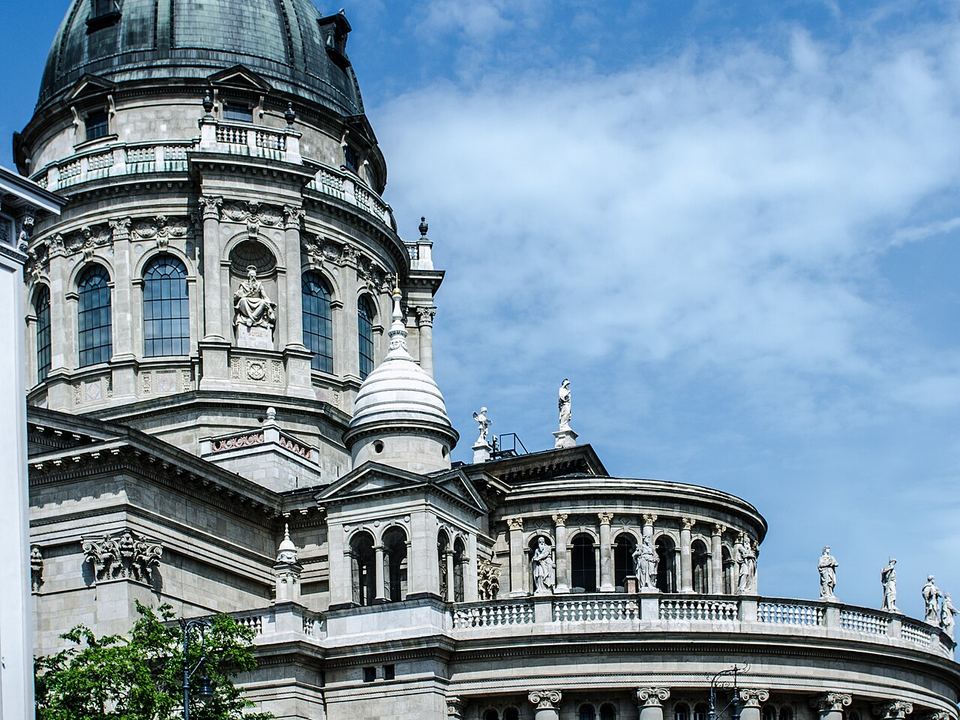
St. Stephen's Basilica
- Church & Religious Site
- Price: 0 Ft - 3 000 Ft
- Opening hours: 09:00 - 17:00 Mon-Sat, 13:00 - 17:00 Sun; tower 10:00 - 18:30 (seasonal)
History
St Stephen's Basilica takes its name from Hungary's first king, canonised in 1083, and its construction took three architects and 54 years to finish. József Hild designed the original neoclassical plan in 1851, but after he died in 1867 Miklós Ybl took over and shifted the design toward a grander Neo-Renaissance style. The following year, on 22 January 1868, defective materials and shoddy workmanship brought the half-built dome crashing down, forcing the entire cupola to be demolished and rebuilt almost from scratch. Ybl himself died in 1891 before seeing the building finished, and it fell to József Kauser to complete the interior; the basilica was finally consecrated on 19 November 1905.
Its dome rises to exactly 96 metres, precisely matching the Hungarian Parliament building across town — a deliberate balance of church and state that Budapest's building codes still enforce today, with no structure in the city centre allowed to rise higher than either. The dome visitors see now, though, is largely a 20th-century reconstruction: on 20 June 1947, workers repairing the copper roofing accidentally set the timber substructure alight, and the dome burned through before firefighters' ladders could even reach that high. It was rebuilt once more, restoring the silhouette that had taken half a century to get right the first time.
The Holy Right Hand
Inside a jewelled reliquary in the Chapel of the Holy Right sits the actual mummified right hand of King Stephen I, found intact when his tomb was opened in 1083, the year he was declared a saint. What happened to it afterwards is stranger than most relics' stories: a treasury guard named Mercurius stole it soon after and hid it in Bihar, in the eastern reaches of the kingdom; when King Ladislaus I recovered it, he founded a monastery there called Szent Jobb, literally 'Holy Right', to keep it safe. Centuries later, as Ottoman forces advanced, the hand was moved for safekeeping through Bosnia and eventually to Dubrovnik, where Dominican monks guarded it for close to two hundred years.
It only returned to Hungary in 1771, brought back from Dubrovnik under Empress Maria Theresa, and has remained in the country ever since, eventually finding its permanent home here, in the basilica built in the saint's name. Each year on 20 August, St Stephen's Day and Hungary's national holiday, the relic is carried in procession through the streets around the basilica; the tradition was suppressed for much of the communist era and returned in its modern form in 1989, the year Hungary began its transition away from one-party rule.
Did you know?
The basilica's south tower holds the largest bell in Hungary, a 9,250-kilogram giant cast in Passau, Germany, and installed in 1990. It replaced a similarly outsized predecessor that had hung there since 1892, until it was requisitioned and melted down for the war effort during the Second World War, one of thousands of church bells across Europe turned into weapons metal in those years. The current bell was a gift from the German people, consecrated fittingly on 20 August, the same day as the Holy Right procession.
With space for around 8,500 worshippers, St Stephen's is the largest church in Budapest and among the biggest in the whole country. Its scale is easiest to appreciate from above: a lift and a short stretch of stairs climb to a terrace that circles the base of the dome, opening onto a 360-degree view over Pest's rooftops that regularly ranks among the best panoramas in the city.
Good to know
As an active church, the basilica keeps hours built around services and asks visitors for modest dress and a quieter presence than at Budapest's museum attractions. It's open roughly 9:00 to 17:00 on weekdays and Saturdays, and from 13:00 on Sundays once morning Mass has finished; entry to the nave is free, though a donation is customary, while the treasury and the dome terrace both need separate paid tickets.
The tower keeps its own, seasonal hours, often stretching into the evening in summer and worth timing for sunset over the Danube. The basilica sits on its own square in the heart of Pest, a short walk from the river and from Andrássy Avenue, with plenty of cafés around the square for a break before or after.