
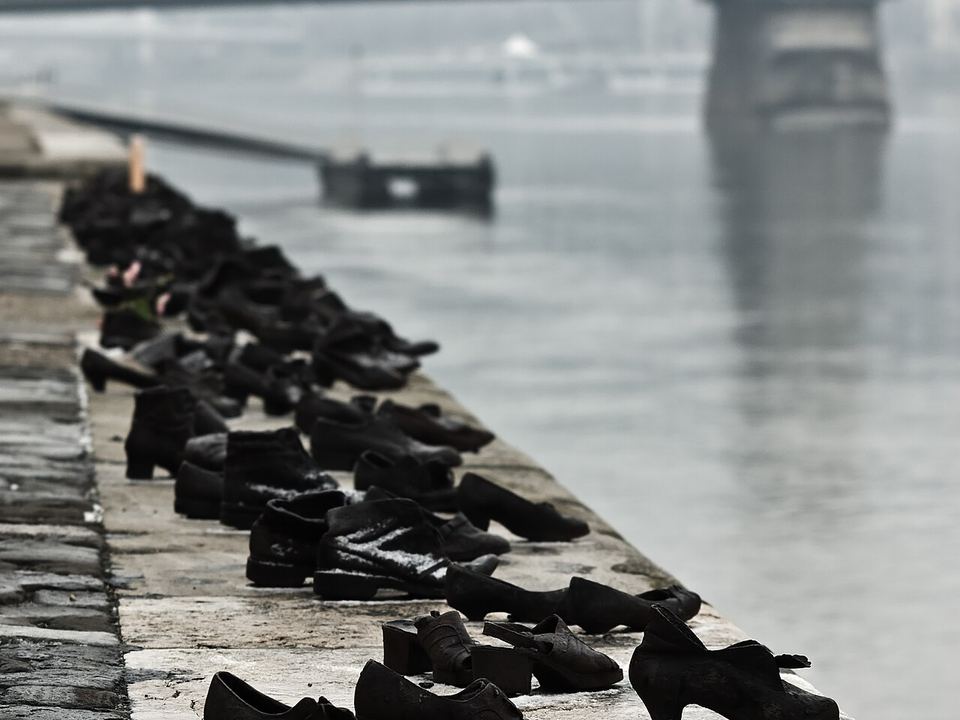
Shoes on the Danube Bank
- Monument
- Opening hours: Open 24 hours
Book a guided tour of Budapest
Skip the line and see Budapest with a local guide.
History
In the winter of 1944-45, Hungary's fascist Arrow Cross Party ruled Budapest after seizing power in an October 1944 coup, and its militiamen carried out repeated killings along the Danube as part of their persecution of the city's Jews. Night after night, groups of Jewish men, women and children were marched from the ghetto and nearby houses to the riverbank and shot at the water's edge.
Before being shot, victims were ordered to remove their shoes — a valuable, resellable commodity in wartime — which the militiamen kept, while the bodies fell into the current and were carried downstream, leaving nothing to bury. Historians count the dead along the Danube that winter in the thousands; this stretch of the Pest embankment, a few hundred metres from the Parliament, is where the memorial today recalls them.
Did you know?
The memorial was conceived by film director Can Togay, who brought the idea to sculptor Gyula Pauer; together they designed sixty pairs of shoes cast in iron and styled after 1940s footwear, so that no single age or class of victim would stand out from the rest — a man's heavy work boots, a woman's slim heels, and a small child's flat shoes sit side by side along the stone embankment. It was unveiled on 16 April 2005, close to where some of the killings took place.
The shoes are cast slightly larger than life and left empty, arranged as though their owners had just stepped out of them. A trilingual plaque set into the stone, in Hungarian, English and Hebrew, dedicates the memorial "to the memory of the victims shot into the Danube by Arrow Cross militiamen in 1944-45."
Good to know
The memorial sits directly on the Pest riverside promenade between Kossuth tér and Roosevelt tér, a five- to ten-minute walk south along the water from the Hungarian Parliament — most visitors pass it on the way to or from a Parliament tour. It has no entrance, no ticket and no fixed hours; as part of the open embankment, it can be seen at any time of day or night.
There is nothing to book and nothing to buy. Visitors typically stop for a few minutes at the row of shoes, often left with a candle, a stone, or a small bouquet in remembrance. Because it commemorates a real atrocity, the site is best approached quietly — not as a photo backdrop, but as a few minutes of quiet attention along an otherwise ordinary stretch of riverbank.