
Memento Park
- Museum
- Price: 2 000 Ft - 3 500 Ft
- Opening hours: 10:00 - 18:00 daily (seasonal, check before visiting)
History
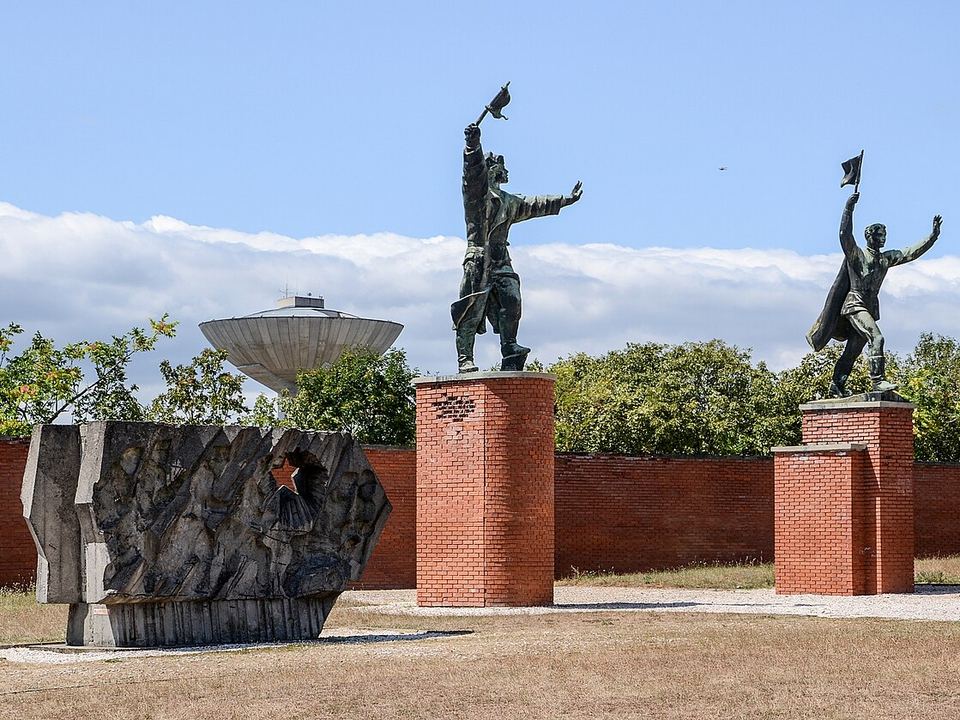
When Hungary's communist government collapsed in 1989-90, dozens of Lenins, Marxes and Soviet-Hungarian friendship monuments came down from squares across Budapest almost overnight — too charged with recent history to leave standing, yet too significant to simply scrap. In 1991 the Budapest General Assembly opened a competition asking what to do with them, and architect Ákos Eleőd won with an idea nobody expected: don't destroy them, exile them. His design gathered the statues on a plot of farmland on the city's southwestern edge, arranged along gravel paths behind a deliberately theatrical brick facade whose grand central doors don't actually open — visitors slip in through a side gap instead, an early clue that the heroic promises carved into the bronze inside never quite matched reality.
The park opened on 29 June 1993, a date chosen to mark exactly two years since the last Soviet soldier left Hungarian soil. What started as a few dozen statues has grown to more than forty, and Eleőd always insisted the place wasn't really about communism at all: it can only exist, he argued, because Hungary is now a democracy free enough to let its citizens look straight at the relics of the dictatorship that came before, rather than pretend it never happened.
The statues
Most of what stands here once loomed over real Budapest squares. There are several towering Lenins, a colossal double portrait of Marx and Engels, and the sprawling, almost chaotic Béla Kun Memorial, sculpted in 1986 to mark the centenary of the short-lived 1919 communist leader's birth — a crowd of soldiers and workers surging forward that, seen today, reads less like glorification than caricature. Nearby stands the Republic of Councils Monument, its charging sailor with a flag copied directly from a 1919 revolutionary poster.
A few statues here have a more literal missing half still standing elsewhere in the city. The huge Liberty Statue on Gellért Hill, visible from across Budapest, originally stood alongside bronze Soviet soldiers commemorating the army that pushed German forces out of the city in 1945; the soldiers were taken down and brought here in 1992, while the female figure herself stayed on the hill, her dedication quietly reworded to honour everyone who died for Hungary's independence, not one army in particular.
Did you know?
The park's single most famous exhibit is a pair of boots. In 1951 Budapest erected an eight-metre bronze statue of Stalin to mark his 70th birthday; on 23 October 1956, in the opening hours of the uprising against Soviet rule, crowds of around 200,000 people looped steel cables around its neck and cut through its ankles with blowtorches. The statue toppled within the hour, leaving only the boots standing on the pedestal — protesters planted a Hungarian flag inside them, and Budapesters nicknamed the spot "Boots Square" for years afterward. Those original bronze boots survive and stand here today, mounted on an artistic reconstruction of the pedestal built in 2006.
Other pieces of the same statue had stranger journeys. One severed bronze hand reportedly spent close to three decades sitting quietly in a Budapest actor's back garden before eventually being handed over to the Hungarian National Museum, where it's still on display — meaning fragments of one dictator's monument now sit scattered between a museum, a private garden's memory, and this park.
Good to know
Memento Park sits about 10 kilometres from central Budapest and isn't on the metro network, so most visitors take the dedicated shuttle bus that departs from Deák Ferenc tér, timed to connect with opening hours — check the current schedule before you go, since hours shift with the season. Buy tickets online in advance if you can, and set aside around two hours to see the grounds properly.
Near the entrance, an original Trabant — the boxy East German car synonymous with the Eastern Bloc — sits ready for photos, and a small cinema inside the "Witness Square" barracks screens a short documentary on the methods of Hungary's communist-era secret police. Pair the visit with something in the city centre on the same day, since there isn't much else nearby.