
Margaret Island
- Park & Nature
- Opening hours: Open 24 hours
Book a guided tour of Budapest
Skip the line and see Budapest with a local guide.
History
The island takes its name from Princess Margaret, daughter of King Béla IV, whose birth came in the shadow of the Mongol invasion of 1241-42. Béla is said to have made a solemn vow during that crisis: if Hungary survived, he would dedicate his own daughter to religious life. Hungary survived, and Margaret was sent, at nine years old, to a Dominican convent that Béla built especially for her on what was then called Rabbit Island, a royal hunting ground in the middle of the Danube.
Margaret took her vows as a teenager and spent the rest of her short life there, reportedly turning down at least one royal marriage proposal — even one her own father tried to arrange for her, to the king of Bohemia — to keep them. She died in 1270 at the age of 28, was venerated locally for centuries afterwards, and was formally canonised by the Catholic Church in 1943. The island has carried her name ever since, though it took until 1908 for it to become the public park it is today.
The medieval convent
The convent's ruins still stand in the island's northern half, including a red marble slab, ringed by a wrought-iron grille, that marks where Margaret was buried inside the convent church. Rejecting the comfortable life her royal birth would have allowed, she reportedly insisted on taking the convent's hardest chores for herself — scrubbing floors and washing dishes among them — rather than claiming the privileges her rank could have won her.
The Dominican convent wasn't the only religious house on the island: a 13th-century Franciscan priory and a Premonstratensian chapel dedicated to St Michael once stood nearby, the chapel's bell tower said to hold the oldest surviving bell in Hungary. All of these medieval buildings were destroyed during the Ottoman wars of the 16th century and lay in ruins for centuries, excavated and partly restored only in the 19th and 20th centuries — a quiet, solemn counterpoint to the joggers and cyclists who now pass by just metres away.
Did you know?
Long before it was a park, the island was known as Nyulak szigete, "Island of Rabbits" — a royal game reserve where medieval kings hunted. It's also why the island's small zoo today keeps species that would have roamed the island in that era, rather than an exotic-animal collection.
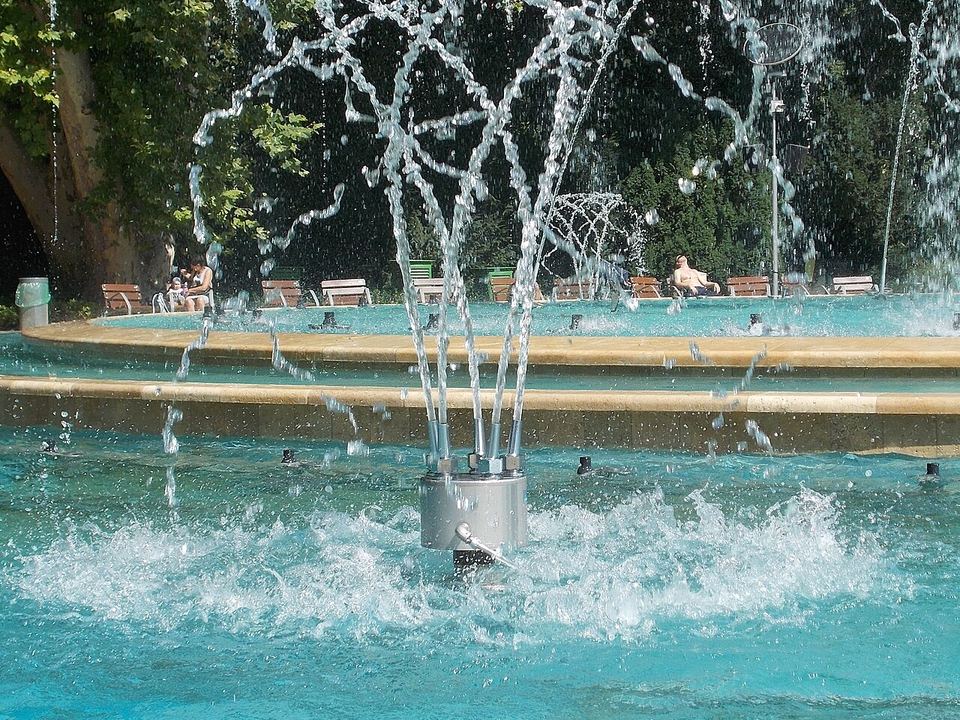
Margaret Island's other landmark is entirely secular: an octagonal water tower built in 1911, standing 57 metres tall in the middle of the island and still a protected industrial monument, now open to visitors for exhibitions and a viewing gallery near the top. From May to October, its modern-day rival for attention is the musical fountain near the southern tip, which puts on a free, choreographed water, light and music show on the hour throughout the day.
Good to know
Margaret Island is car-free — a single bus route, the 26, is the only motor traffic allowed to cross it, running from Nyugati train station across the island to Árpád Bridge. Most visitors arrive on foot via tram 4 or 6, which stop right on Margaret Bridge at the island's southern entrance, or by that same bus 26; once on the island, everyone gets around on foot, by bike, or on a rented four-seater pedal cart known as a bringóhintó.
The island's flat, 5.3-kilometre perimeter path is one of Budapest's most popular running and cycling routes, and its shaded gardens make it an easy escape from the summer heat of the city centre. If you want to swim rather than just stroll, the Palatinus open-air baths and the Alfréd Hajós swimming complex are both on the island and open to day visitors.