
Hungarian State Opera House
- Theatre & Opera House
- Architecture & Design Landmark
- Price: 3 500 Ft - 5 500 Ft
- Opening hours: Guided tours 11:15 and 15:00 daily; box office 10:00 - 19:00
History
When Emperor Franz Joseph agreed to help fund a new opera house for Budapest in the 1870s, he attached one condition: it could not outshine Vienna's own opera in size. Architect Miklós Ybl treated the constraint as a challenge, designing a smaller building whose restrained Neo-Renaissance facade gives little away about the sheer opulence waiting inside. Construction began in 1875 and the house opened on 27 September 1884, with composer Ferenc Erkel — author of the Hungarian national anthem — as its first music director.
The theatre's most famous early leader arrived a few years later: a 28-year-old Gustav Mahler took over as director in 1888 and spent three intense years overhauling the repertoire and raising standards, before resigning in 1891 after clashing with a newly appointed, more conservative intendant. He moved on to Hamburg and, soon after, Vienna — but Budapest kept the reputation for ambition he helped build.
Built to perform
Ybl didn't just design a building that looked impressive — he built a stage that worked like nothing else in Europe at the time. It replaced the wooden Baroque-era machinery still standard elsewhere with a metal system driven by hydraulics, letting sections of the floor rise, sink and rotate independently, and the building was fitted with an early iron safety curtain, a fire-prevention feature few theatres had at the time. The precautions paid off: when a bomb pierced the roof during the Second World War, it lodged on the stage without exploding, and the building escaped the serious damage inflicted on much of the surrounding city.
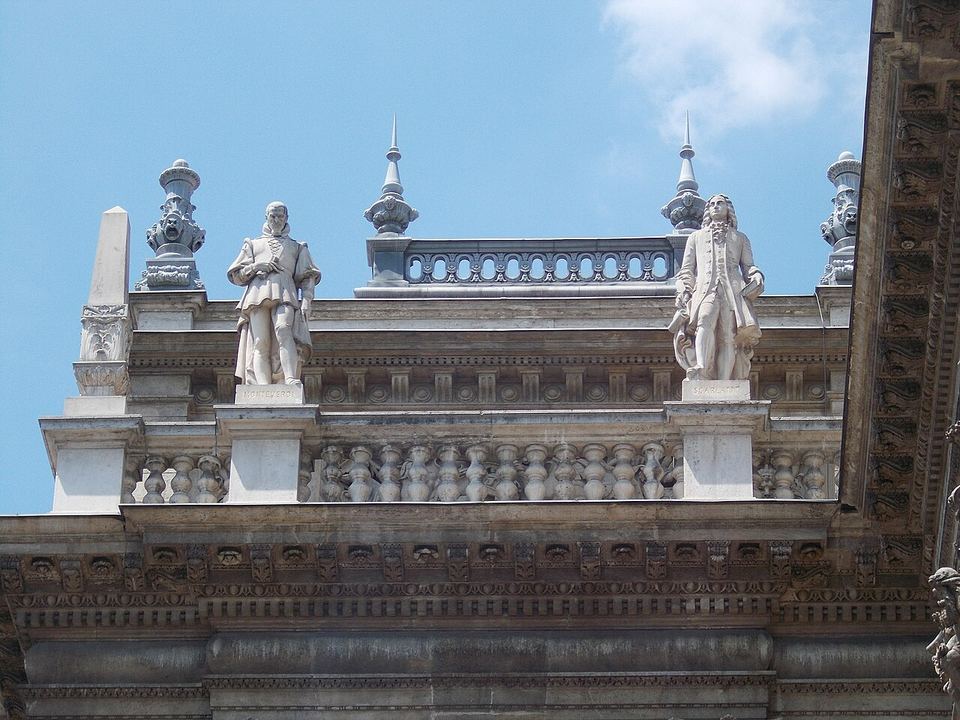
The horseshoe-shaped auditorium, seating just over 1,200 people beneath a chandelier that once carried 500 gas lamps, is still ranked among Europe's finest for natural acoustics. Statues of Ferenc Erkel and Franz Liszt, carved by sculptor Alajos Stróbl, flank the main entrance, while a row of sixteen composers, from Mozart to Verdi, looks down from the cornice above the loggia.
Did you know?
Look up in the auditorium and you'll find the Apotheosis of Music, a sweeping ceiling fresco by Károly Lotz, nine metres across, showing Apollo playing for an assembly of Greek gods and muses — painted around the chandelier so the whole composition seems to radiate outward from the light itself.
The building was strikingly forward-thinking for its era, too: from opening day it had underfloor heating and an early form of air conditioning that cooled air by drawing it over blocks of ice, decades before mechanical cooling became common anywhere. As the story is told locally, Empress Elisabeth ("Sisi") adored the finished opera house, while Franz Joseph was reportedly rather less pleased that it had turned out so much finer than Vienna's.
Good to know
Guided tours run daily at 11:15 and 15:00, even on days without an evening performance, and occasionally end with a short live aria in the auditorium — a nice bonus, though not guaranteed. The box office is open 10:00-19:00, and booking a tour or performance ticket online ahead of time is worth it in high season.
A meticulous renovation completed in 2022 restored the gold leaf, silk upholstery and ceiling frescoes to their original brilliance after five years of work. The opera sits on Andrássy Avenue, a UNESCO-listed boulevard, right above the Opera stop on Metro line M1 — itself the oldest underground railway in continental Europe, opened in 1896. Smart-casual dress is fine for a tour; for evening performances, many visitors dress a little more formally, though it isn't strictly required.