
Hungarian Parliament
- Historic Site
- Architecture & Design Landmark
- Price: 8 000 Ft - 13 000 Ft
- Opening hours: Guided tours 08:00 - 18:00 daily (English tours run several times per hour, book ahead)
History
In 1885, Hungary announced an international competition for a new parliament building worthy of a nation celebrating its millennium — a thousand years since the Magyar tribes settled the Carpathian Basin. Architect Imre Steindl won, and construction began that same year on a marshy stretch of the Danube's Pest bank. It took nearly two decades, a workforce that at times numbered close to a thousand people, and roughly 40 million bricks to finish it. By the time the building was inaugurated in 1904, Steindl had gone completely blind and never saw the finished result.
Steindl deliberately built the dome to exactly 96 metres — a symbolic number marking 896, the year the Magyars arrived — and made it precisely as tall as St Stephen's Basilica across the city, so neither secular nor religious power would visibly outrank the other. A rule born from that gesture still holds today: no building in central Budapest may rise higher than the Parliament and the Basilica.
Did you know?
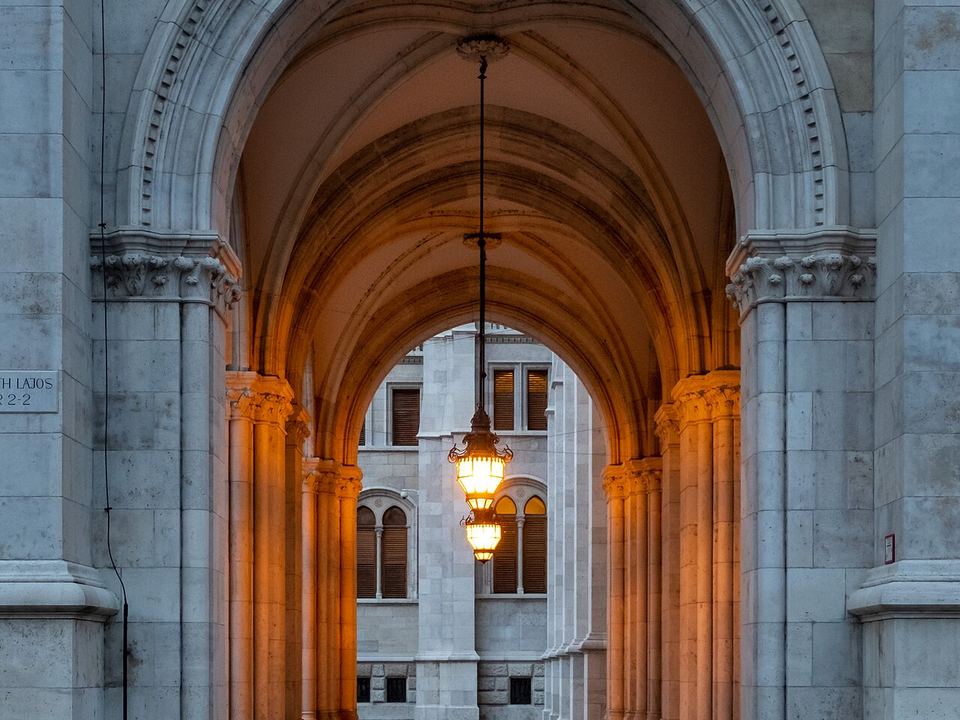
The Parliament isn't just Hungary's largest building — it's one of the largest legislative buildings on Earth, with 691 rooms, 10 courtyards, and around 20 kilometres of corridors and staircases spread across its Gothic Revival facade. Decorating that facade are statues of Hungarian kings, Transylvanian princes, and military commanders, watching the Danube from niches and buttresses.
Inside, roughly 40 kilograms of gold leaf cover the domed central hall, and half a million precious and semi-precious stones are set into the decoration. Since 2000, the Holy Crown of Hungary — the coronation crown used for King Stephen I in the year 1000 and, by tradition, a symbol of the nation itself rather than of any one monarch — has been displayed under permanent armed guard beneath that same dome.
The building was startlingly modern for its era: it had central heating and one of Europe's earliest air conditioning systems from the day it opened, decades before either became standard anywhere else.
Good to know
The Parliament is a working government building, so the interior is only visitable on a guided tour, and tickets sell out days or weeks ahead in high season — book online before you travel rather than hoping to buy on the spot. Tours cover the Golden Staircase, the Hall of Congress, and the domed central hall where the Holy Crown is kept.
Arrive with time to spare for the airport-style security check before your tour slot, and bring photo ID — it's often requested at the ticket desk. The building sits right on Kossuth Lajos Square on the Pest riverbank, an easy walk or tram ride from the city centre, and is worth timing for late afternoon light on the Danube-facing facade.