
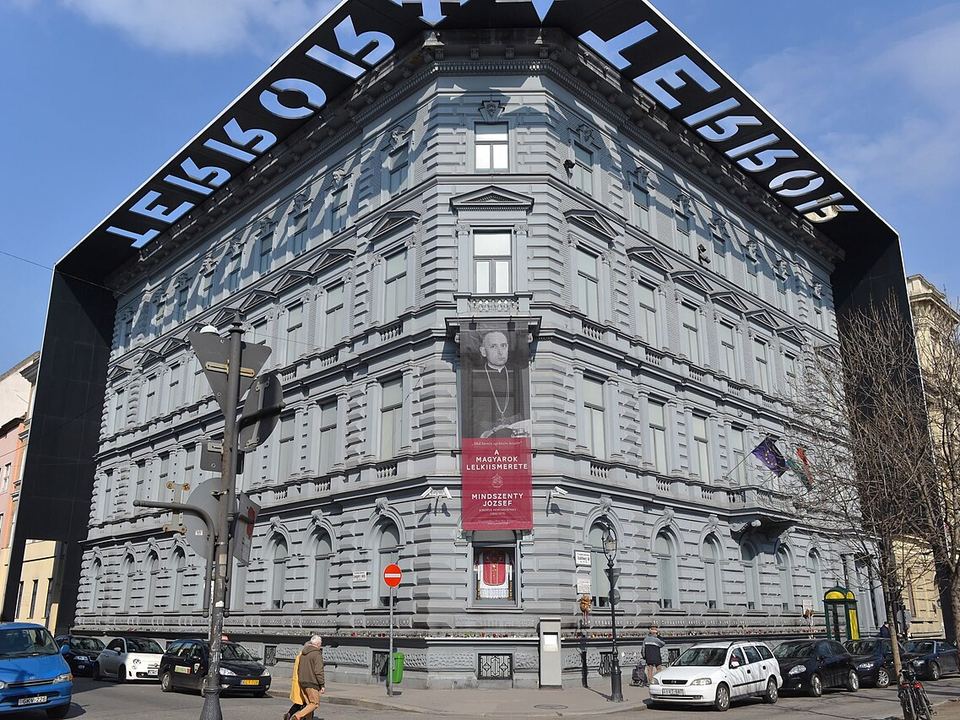
House of Terror
- Museum
- Price: 3 000 Ft - 4 000 Ft
- Opening hours: 10:00 - 18:00 Tue-Sun, closed Mon
History
The building at Andrássy út 60 was built as an apartment block in the 1880s, but in October 1944 it became the headquarters of the Arrow Cross Party, the Hungarian fascist movement that seized power in a German-backed coup that same month. Over the following months, as Arrow Cross squads rounded up, deported and murdered Jews and political opponents across the city, this address was where many of the victims were brought, interrogated and held.
Only months after Arrow Cross rule collapsed in early 1945, Hungary's new communist security police moved into the same building and used it for much the same purpose. Known first as the PRO, then the ÁVO and from 1950 the ÁVH, the secret police used Andrássy út 60 to interrogate and imprison tens of thousands of real and suspected opponents of the regime through the Stalinist terror of the early 1950s and the crushing of the 1956 uprising. That two dictatorships on opposite ends of the political spectrum used the identical building for the identical purpose is exactly the continuity the museum, which opened in 2002, was built to make visible.
The basement
Much of the basement as it looks today was built out by the ÁVH after 1945, though the Arrow Cross had already used cellar rooms to hold prisoners the previous year. It now houses reconstructed prison cells, solitary-confinement chambers and interrogation rooms, put together with the help of survivors who worked with the museum's designers to recover not just the layout of the rooms but details of the light, sound and smell of being held there.
Visitors descend to the basement by a lift that moves at a deliberately slow pace, while a screen plays testimony from a former prison guard describing, in his own words, how executions were carried out in the building. It's a short ride, and one of the most direct moments in the museum, distilling decades of abstract history into a single first-hand account.
Did you know?
The building's roofline carries a steel cornice with the word TERROR cut out of it, held far enough from the wall that on sunny days it throws the word as a shadow across the pavement below. A black band runs around the eaves, some of it perforated with the photographs of victims of both regimes who are commemorated inside.
In the central atrium, a full-size Soviet tank stands in a shallow reflecting pool, facing a wall covered floor to ceiling with photographs of the people the museum remembers — a blunt, physical reminder of the military power that stood behind Hungary's communist state and its secret police for over four decades.
Good to know
The museum is open Tuesday to Sunday and closed Monday; a ticket, around 3,000-4,000 Ft, includes an audio guide, which is worth having since most of the original wall text inside is in Hungarian. Plan on at least two hours, more if you stop to read and listen at every room.
The subject matter is heavy throughout, and the descent through the basement in particular can be distressing, so it's not really a museum for young children, and it's worth pacing your visit rather than rushing it. It sits directly on Andrássy Avenue, a short walk or one metro stop (M1) from Oktogon, and pairs naturally with a walk further down the avenue toward Heroes' Square.