
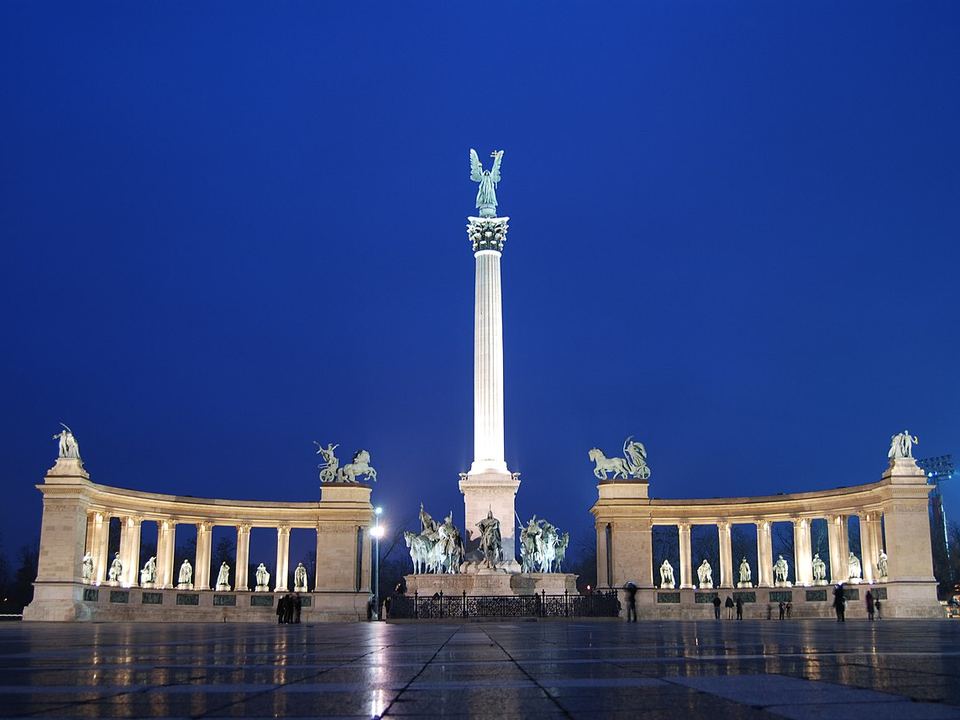
Heroes' Square
- Square & Avenue
- Opening hours: Open 24 hours
History
Heroes' Square and the Millennium Monument at its centre were planned for Hungary's 1896 celebrations marking a thousand years since the Magyar tribes settled the Carpathian Basin, designed by architect Albert Schickedanz with sculptor György Zala, although the monument itself wasn't finished until years after the anniversary it commemorates. A 36-metre column rises at the centre of the square, topped by a bronze Archangel Gabriel holding the Holy Crown of Hungary in one hand and the apostolic double cross in the other, a reference to the legend that Gabriel appeared to Stephen I, Hungary's first Christian king, in a dream and offered him the crown that founded the kingdom.
At the column's base, mounted statues of Árpád and the six other Magyar chieftains who led that ninth-century settlement look outward across the square, while curved colonnades sweep away on either side, each lined with statues of Hungarian kings and statesmen. That lineup has changed more than once: the original fourteen figures included several Habsburg emperors, but after the First World War, and again after the Second, they were taken down one by one and replaced with Hungarian national figures, since a monument built to celebrate Hungarian statehood made an odd showcase for a dynasty that had so often ruled over Hungary rather than for it.
Did you know?
On 16 June 1989, some 250,000 people packed the square for the ceremonial reburial of Imre Nagy, the reformist prime minister executed in 1958 for leading Hungary's 1956 uprising against Soviet rule. Broadcast live and widely attended, the funeral is remembered as one of the turning points that set the country on course to leave communism behind later that same year.
The square sits directly above Hősök tere, the terminus of the M1 metro line, opened in 1896 as part of the same millennial celebrations that produced the monument above it, which makes it the oldest underground railway line in continental Europe. Both the line and the square are now part of the same UNESCO World Heritage listing that covers Andrássy Avenue and the banks of the Danube.
Good to know
The square is open around the clock and free to visit. At the foot of the column, the Tomb of the Unknown Soldier and its eternal flame mark it as a working site of remembrance — Hungarians still lay wreaths here on national holidays, so a little quiet respect is in order even with tour groups passing through.
Heroes' Square opens straight onto City Park (Városliget), so it's easy to combine with Vajdahunyad Castle and the Széchenyi Thermal Baths on the same outing, and the Museum of Fine Arts and the Palace of Art (Műcsarnok) flank the square if you want to add a gallery stop. Late afternoon gives the best light for photographing the column and colonnades.