
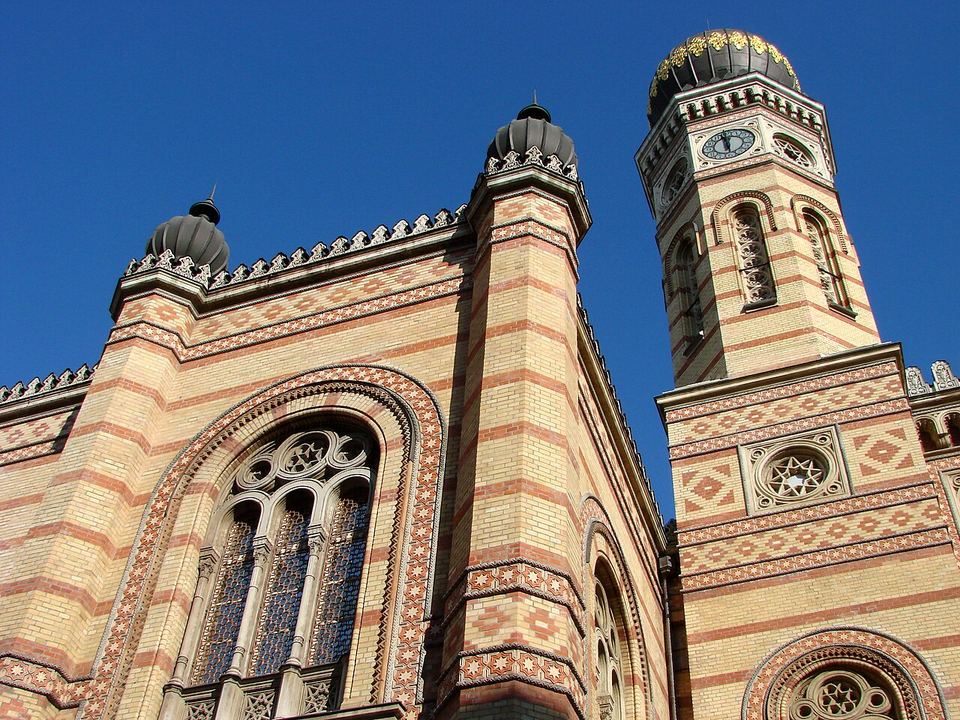
Great Synagogue (Dohány Street)
- Church & Religious Site
- Price: 6 000 Ft - 9 000 Ft
- Opening hours: 10:00 - 18:00 Sun-Thu, 10:00 - 16:00 Fri, closed Sat
History
Construction began in 1854 and the synagogue was inaugurated on 6 September 1859, designed by the Viennese architect Ludwig Förster in a Moorish Revival style built from horseshoe arches, striped brick and twin onion-domed towers — a deliberate break from the Gothic and Romanesque vocabulary used for churches at the time, since the congregation's leaders wanted a building nobody could mistake for one. The three-aisled hall seats close to 3,000 worshippers, making it the largest synagogue in Europe and, after Manhattan's Temple Emanu-El, the second-largest anywhere in the world.
The synagogue stood inside the wall of the Budapest ghetto that the Arrow Cross regime sealed off in November 1944, and it suffered serious damage from bombing and street fighting before the war ended. Decades of neglect followed under communist rule, and a full restoration only began in 1991, financed partly by the Hungarian state and partly by international donors — among them cosmetics magnate Estée Lauder and actor Tony Curtis, whose Emanuel Foundation carried his own family's Hungarian Jewish roots into the project. The work wrapped up in 1996, restoring the synagogue to the condition visitors see today.
Did you know?
Next door, the Hungarian Jewish Museum stands on the site of the house where Theodor Herzl was born in 1860. Decades later, in Vienna and Paris, Herzl became the journalist who founded modern political Zionism and set out the case for a Jewish state, making this unassuming address in Budapest's Jewish Quarter the improbable birthplace of an idea that reshaped the twentieth century.
The synagogue belongs to Neolog Judaism, a reform-minded branch of Hungarian Jewish practice that, unlike Orthodox communities, permits instrumental music during services — which is why, unusually for a synagogue, it has a large pipe organ and still hosts organ recitals and classical concerts alongside religious services today.
The memorial garden
Behind the synagogue, the Raoul Wallenberg Memorial Park — named for the Swedish diplomat credited with saving thousands of Budapest's Jews before he vanished into Soviet custody in 1945 — covers the mass graves of roughly 2,000 people who died in the ghetto over the winter of 1944-45, most from cold, hunger and disease rather than direct violence, and were buried here because it was too dangerous to reach a proper cemetery.
Rising over the graves is the Tree of Life, a stainless-steel weeping willow sculpted by Imre Varga in 1991 with support from Curtis's Emanuel Foundation. Its thousands of metal leaves are engraved, at the request of surviving relatives, with the names of Hungarian Jews murdered in the Holocaust, and stone tablets at its roots record the Righteous Among the Nations — non-Jewish diplomats, clergy and ordinary citizens honored for risking their lives to shelter Jews during the occupation.
Good to know
As an active synagogue, the complex closes to visitors on Saturday, the Jewish Sabbath, and keeps shorter hours on Friday afternoons ahead of it. A ticket, typically 6,000-9,000 Ft depending on the package, usually covers the synagogue, the Jewish Museum next door and the memorial garden in one visit. Dress modestly, and take one of the paper kippahs offered at the entrance if you need one.
The complex sits at the edge of Budapest's historic Jewish Quarter, within easy walking distance of the district's cafés, ruin bars and other Jewish heritage sites, so it's worth building a wider walk around it. Arriving close to opening helps avoid the tour-group crowds that build through late morning.