
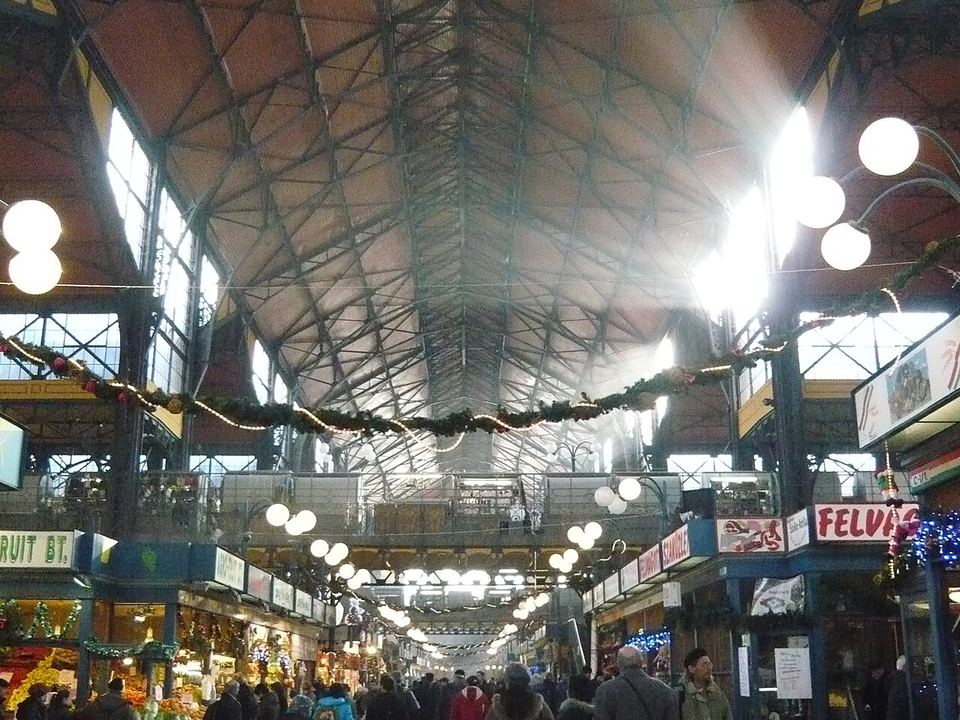
Great Market Hall
- Market Hall
- Opening hours: 06:00 - 17:00 Mon, 06:00 - 18:00 Tue-Fri, 06:00 - 15:00 Sat, closed Sun
History
In 1897, Budapest's first mayor, Károly Kamermayer, saw his largest and most ambitious project come to life: a wave of five new market halls built to modernise the city's food trade, the largest and grandest of them on the Pest bank of the Danube. Architect Samu Pecz, better known for the churches he designed across Hungary, won the commission and broke ground in 1894. His design wrapped a steel-framed hall — engineered with the same technology used for the grand railway sheds of the era — in a brick, neo-Gothic exterior. The Great Market Hall opened on 15 February 1897, with Kamermayer, by then retired, on hand for the ceremony.
The building survived far worse than crowds of shoppers: it was badly damaged during the fighting of the Second World War and left to decay for decades under communist rule, its condition growing so precarious that it was shut down in 1991 as unsafe. A thorough, years-long restoration followed, replacing the original ironwork and recreating the roof's Zsolnay tiles piece by piece, and the hall reopened to a new generation of shoppers in 1994 — a rescue later recognised with an international FIABCI heritage award.
Three floors, one market
Spread across roughly 10,000 square metres on three levels, the market rewards a slow walk from top to bottom. The ground floor is where locals still do real shopping: strings of dried paprika, jars of pickles, fresh produce, salami and foie gras fill stall after stall, alongside bottles of Tokaji wine and other classic Hungarian souvenirs. Climb the stairs and the mood shifts — the upper gallery is the busiest level with visitors, lined with small eateries serving lángos and goulash soup next to stands of folk embroidery and craft souvenirs.
Head down instead of up and the crowds thin out: the basement holds the market's fishmongers and butchers, along with barrels of pickled vegetables, a workaday corner most tourists never find. It's a useful reminder that the Great Market Hall is still, first and foremost, a working market for Budapest residents — the tourist-friendly upper floor is only one layer of it.
Did you know?
Samu Pecz spent much of his career designing churches, and it shows: the market hall's pointed arches, ribbed ironwork and soaring nave-like central space have earned it the nickname "cathedral of commerce" among locals. The colourful, glazed roof tiles come from the Zsolnay factory in Pécs, the same maker whose pyrogranite tiles cover the roof of Matthias Church across the river — a small, shared signature linking two of Budapest's most photographed buildings.
By 1991 the hall had deteriorated so badly that engineers considered parts of it structurally dangerous, and it came close to being lost entirely before the restoration saved it. Look up at the ironwork today and it's hard to imagine the building was ever on the brink — proof of how completely the 1990s renovation rebuilt it from the frame outward.
Good to know
The market keeps early, trader's hours: it opens at 6am every day it's open, closing at 5pm on Monday, 6pm from Tuesday to Friday, and 3pm on Saturday — it's shut completely on Sunday, so don't save your visit for a Sunday stroll. Weekday mornings, before the tour groups and cruise-ship crowds arrive around mid-morning, are the best time to browse the stalls the way locals do.
If you only have time for one level, treat the ground floor as the place to shop for food to take home and the upper gallery as the place to eat lunch — a plate of lángos or a cup of goulash soup among the souvenir stalls. The hall sits at Fővám tér on the Pest end of Liberty Bridge, an easy walk from the centre or a short ride on tram 47 or 49.