
Gellért Thermal Bath
- Thermal Bath
- Opening hours: Closed for renovation until 2028
Book a guided tour of Budapest
Skip the line and see Budapest with a local guide.
History
Thermal springs have bubbled up at the foot of Gellért Hill since long before anyone built a bath around them — records of 'miraculous' waters here go back to the 13th century, and by the late Middle Ages a hospital stood on the site so the sick could bathe in them directly. The Ottomans, who occupied Buda from 1541, favoured this spring over most others in the city because it ran larger and hotter, and by the 17th century locals had taken to calling the site Sárosfürdő, 'Mud Bath,' after the fine thermal silt that settled in the pools. The hill itself takes its name from Bishop Gerard — Gellért in Hungarian — an Italian-born missionary murdered here in 1046 during a pagan uprising against Hungary's new Christian rulers; legend holds he was sealed into a barrel studded with nails and rolled down the slope.
The bath and hotel visitors know today only date to the 20th century. Three architects — Artúr Sebestyén, Ármin Hegedűs and Izidor Sterk, all working in the Hungarian Szecesszió style pioneered by Ödön Lechner — designed a single complex uniting a grand hotel with a bathing palace beneath it, building it between 1912 and 1918 despite constant delays from the First World War. Hotel and baths opened together on 26 September 1918, just two days after the feast day of Saint Gerard, the missionary bishop both the hill and the hotel are named for.
The hotel and the bathing hall
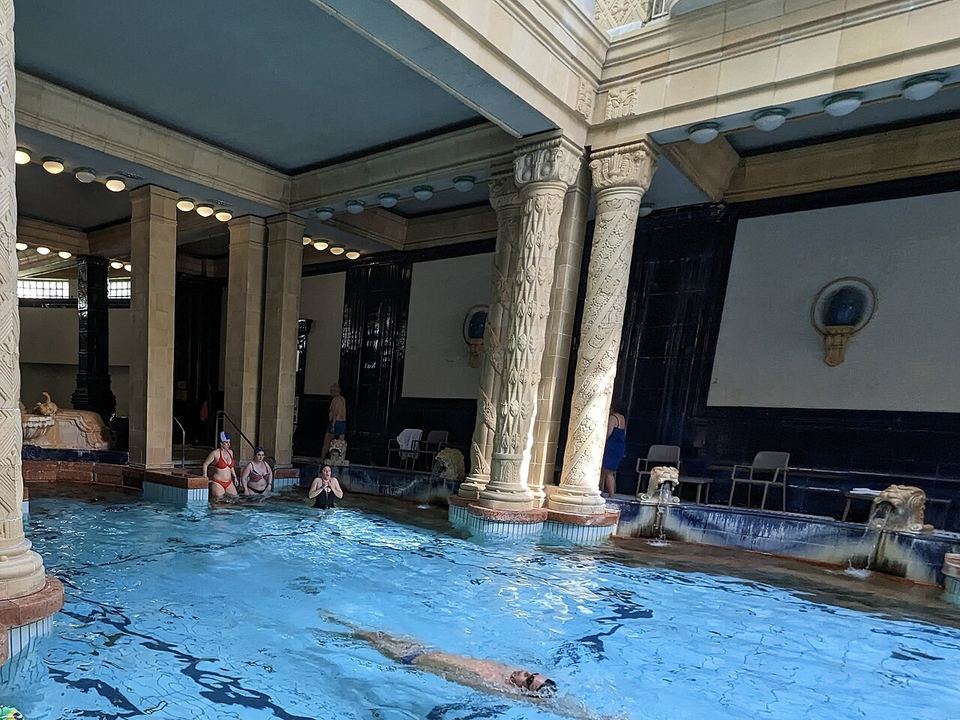
Inside, the main hall is Art Nouveau at its most theatrical: a vaulted glass roof, part of it retractable to regulate light and humidity over the pool, rises above marble columns carved with fish, leaves and mythical creatures, walls faced in ceramic tiles from the Zsolnay factory in Pécs, and niches holding statues of the four seasons and a marble Venus. Mosaics in blues, greens and golds cover almost every surface not already given over to stone or tile.
That opulence quickly made the hotel one of Budapest's most fashionable addresses. Through the 1930s its guest list ran to the Maharaja of Kapurthala, New York mayor Jimmy Walker and Iran's Shah Reza Pahlavi, and later decades brought Richard Nixon, the Dalai Lama, and performers from Kirk Douglas and Jane Fonda to violinist Isaac Stern and composer Dmitri Shostakovich — a roll call the hotel earned in part because bath and hotel were designed and built as a single address, not two.
Did you know?
In 1927, Gellért added an outdoor wave pool driven by mechanical paddles, one of the very first machine-generated wave pools anywhere, decades before the idea caught on elsewhere. Much of the original 1927 machinery still powers the waves today, which makes maintaining it a specialist's job — some of its parts are no longer manufactured anywhere, so engineers keep it running with custom-made replacements. An effervescent bath, using naturally carbonated water, followed in 1934.
The Gellért name predates the bath by nearly nine centuries. Bishop Gerard was one of Hungary's first Christian missionaries, tutor to the young prince who would become King — later Saint — Emeric, and one of the best-known victims of the 1046 pagan revolt that followed King Stephen I's death, which is how an 11th-century execution on a hillside ended up naming a 20th-century thermal bath.
Good to know
Gellért closed its doors on 1 October 2025 for a multi-year structural renovation, and it isn't due to reopen before 2028, so there's no bathing to be had here for the time being. What's still worth the detour is the building itself: its Art Nouveau facade and the Zsolnay-tiled entrance hall can both be admired from street level on Kelenhegyi út without a ticket.
Travellers wanting the thermal-bathing experience Gellért is known for should head instead to Széchenyi or Rudas, Budapest's other great historic baths, both open as usual. Like every Hungarian thermal bath, Gellért has always required a swimsuit and offered rental towels, robes and swimming caps for anyone who arrives without their own — worth remembering for whenever it reopens.