
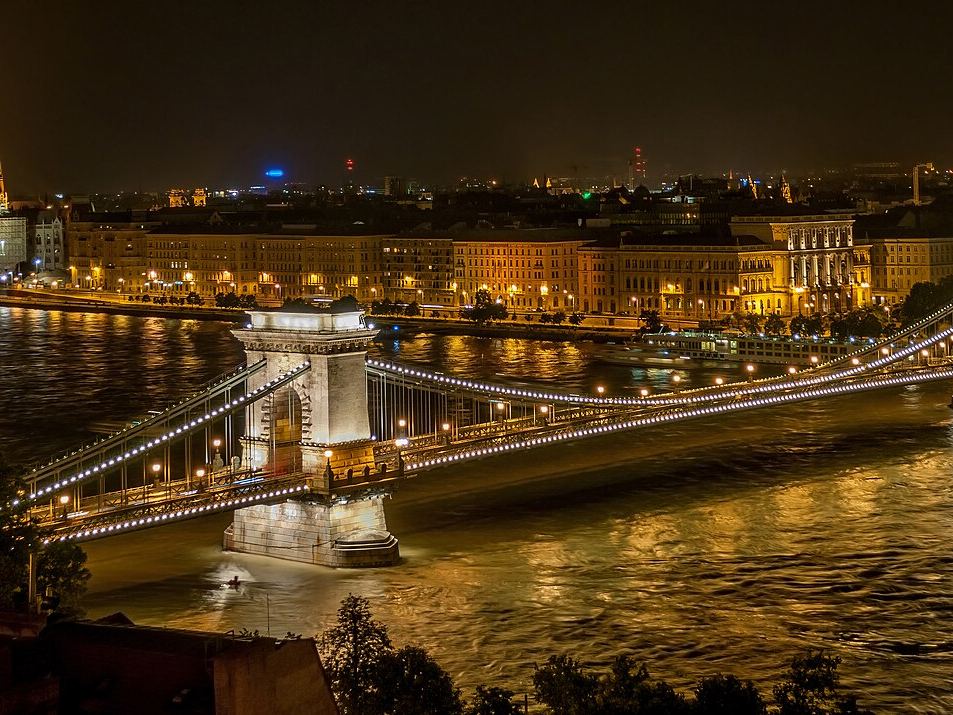
Chain Bridge
- Bridge
- Opening hours: Open 24 hours
Book a guided tour of Budapest
Skip the line and see Budapest with a local guide.
History
Before 1849, crossing the Danube between Buda and Pest meant a ferry in summer or walking across the ice in a hard winter — and nothing at all in between, when the river was choked with drifting ice but not yet frozen solid. Count István Széchenyi felt that gap personally: unable to reach Vienna in time when his father lay dying because the river had iced over, he resolved to fund a permanent bridge that would bind the two halves of the city together in every season.
English engineer William Tierney Clark designed the suspension bridge, scaling up ideas from his own Marlow Bridge on the Thames, while Scottish engineer Adam Clark — no relation — oversaw a decade of construction on site. It opened on 20 November 1849, its 202-metre central span among the longest of any suspension bridge in the world at the time, a rare piece of good news in a year still reeling from Hungary's defeated war of independence.
Did you know?
The four stone lions guarding each end of the bridge, carved by sculptor János Marschalkó and installed in 1852, are behind Budapest's most persistent urban legend: that the sculptor forgot to give them tongues and threw himself into the Danube in shame. Neither part is true — each lion has a tongue, it's just not visible from the ground — but the story has outlasted a century and a half of visitors craning their necks to check for themselves.
Retreating German forces destroyed every bridge across the Danube in Budapest in January 1945, the Chain Bridge included. It was rebuilt and reopened on 20 November 1949 — exactly a hundred years, to the day, after its original inauguration.
Good to know
The bridge is free, pedestrian-friendly and open around the clock, linking Roosevelt Square on the Pest side — near the Gresham Palace and the Hungarian Academy of Sciences — with Clark Ádám Square on the Buda side, where the tunnel Adam Clark also built runs straight through Castle Hill.
It's the easiest link between the two halves of the city, and the Buda Castle funicular up to the castle starts just steps from the western end. The bridge is at its most photogenic after dark, when its cables are lit and reflected in the Danube — best admired from the embankment rather than the bridge deck itself.