
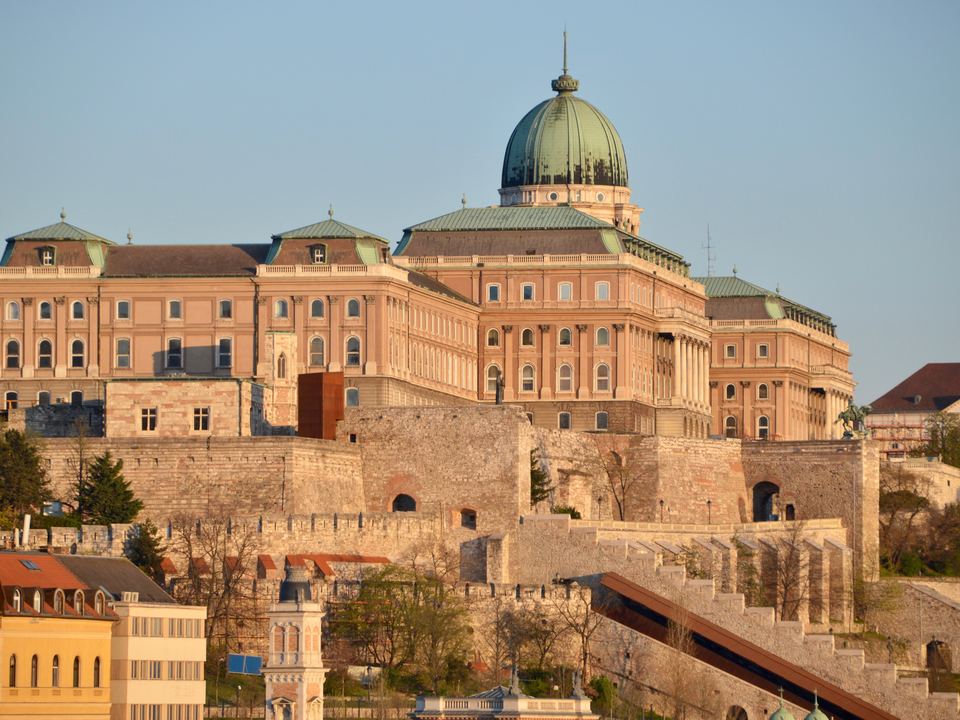
Buda Castle
- Historic Palace
- Price: 0 Ft - 4 500 Ft
- Opening hours: Grounds open 24h; Hungarian National Gallery 10:00 - 18:00 (closed Mon)
History
Castle Hill has carried a royal fortress since the 13th century, when King Béla IV built the first stronghold here in the aftermath of the 1241-42 Mongol invasion, choosing the steep hilltop precisely because it was so hard to take by force. Later kings expanded it into a proper royal seat — Sigismund and, above all, Matthias Corvinus in the 15th century turned it into one of Central Europe's great Renaissance courts. That first flourishing ended in 1541, when the Ottomans captured Buda and held the castle for close to a century and a half, using it as a garrison rather than a palace.
When a Christian army finally retook the hill in the 1686 siege that ended Ottoman rule, the palace was left a burnt-out shell. The Habsburgs rebuilt it in Baroque style over the following two centuries, only for the Siege of Budapest in the winter of 1944-45 to reduce it to ruins again — one of the last German strongholds in the city, it was pounded by artillery for weeks before Soviet troops took it in February 1945. Hungary rebuilt the palace once more after the war, though the postwar reconstruction simplified many of the original decorative details; a long-running restoration effort, the Hauszmann Program, has been recovering some of what was lost, including a reconstructed St Stephen's Hall that reopened to the public in 2025.
Landmarks in the Courtyard
Facing the Danube, the Matthias Fountain is one of Budapest's most photographed corners of the complex — a Neo-Baroque group by sculptor Alajos Stróbl showing King Matthias Corvinus and his hunting party, inspired by a Hungarian folk ballad about a peasant girl, Ilonka, who fell in love with the king without recognising him. Nearby, at the Habsburg Gate, a 10.5-metre bronze Turul spreads a 12.5-metre wingspan over the courtyard — the mythical bird of Magyar origin legend, said to have guided the tribes to the Carpathian Basin over a thousand years ago.
Both pieces date from the turn of the 20th century, part of a major expansion of the palace under Habsburg rule that gave Buda Castle much of the grand silhouette it has today, domed roofline included.
Did you know?
The funicular that climbs the hillside from the Chain Bridge, the Budavári Sikló, opened in 1870 — only the second funicular railway built in Europe — after Count Ödön Széchenyi, son of the reformer István Széchenyi, championed the idea so that officials and theatregoers wouldn't have to trudge up on foot. Wartime bombing destroyed it in 1944, and it sat unused for decades before reopening along its original track in 1986.
In 1987, the entire Castle District — funicular included — was added to the UNESCO World Heritage list, one of the reasons the Hauszmann Program's restoration work is done so painstakingly, cross-checking archival photographs to rebuild details lost first to war and then to decades of simplified communist-era repairs.
Good to know
The palace grounds and courtyards are open around the clock and free to walk through, but the two museums inside — the Hungarian National Gallery, home to the country's largest collection of Hungarian art since it moved here in 1975, and the Budapest History Museum — both charge separate admission, and the National Gallery is closed on Mondays.
Most visitors ride the Budavári Sikló funicular up from Clark Ádám tér by the Chain Bridge (a small ticket fee applies), though walking the winding lanes of the Castle District is free and arguably more scenic. Buda Castle sits within easy walking distance of Fisherman's Bastion and Matthias Church, so most people combine all three into a single visit to Castle Hill — the river-facing terraces are especially worth timing for late-afternoon light.