
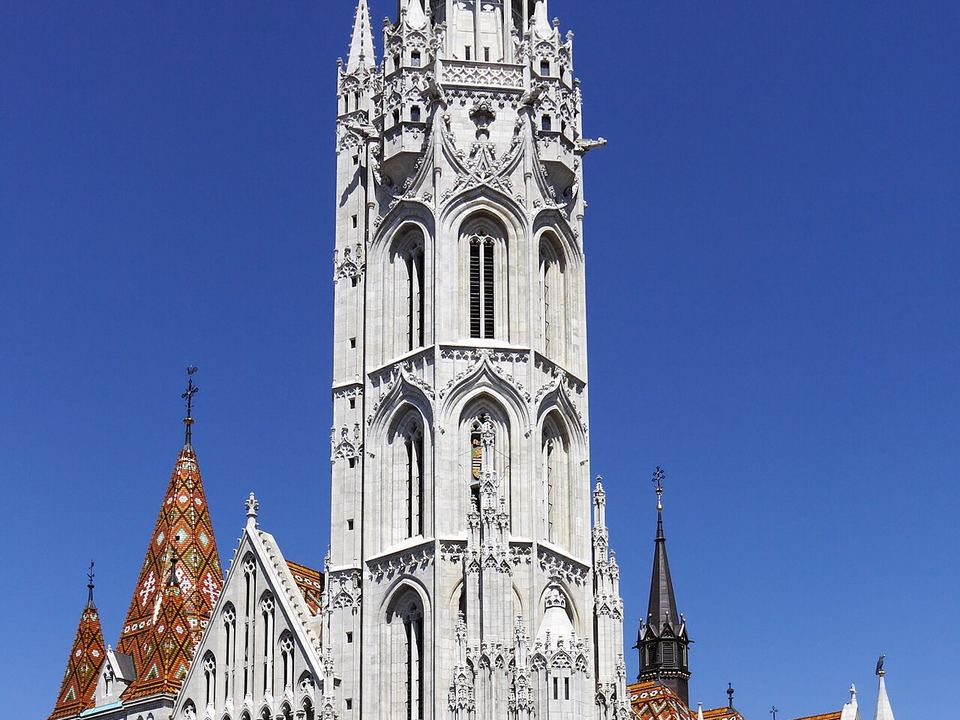
Matthias Church
- Church & Religious Site
- Price: 2 500 Ft - 3 000 Ft
- Opening hours: 09:00 - 17:00 Mon-Fri, 09:00 - 13:00 Sat, 13:00 - 17:00 Sun
History
Officially the Church of Our Lady, this parish church on Castle Hill has carried the name of King Matthias Corvinus for centuries, ever since he married here twice in the 15th century and had his coat of arms carved into its south tower. Its roots go back roughly 700 years to a 13th-century Gothic church, largely rebuilt over the following centuries and twice used for a Habsburg coronation — Franz Joseph I in 1867 and Charles IV, the last king crowned in Hungary, in 1916.
When Ottoman forces took Buda in 1541, the church became the city's main mosque for over 150 years, its frescoes whitewashed and its interior turned to face Mecca. After Buda was retaken in 1686, the church slowly returned to Christian use, but it was architect Frigyes Schulek's sweeping 1874-96 restoration that gave it the look it has today — stripping away later Baroque additions, rebuilding what he believed to be closer to the medieval original, and adding the colourful diamond-patterned roof that now defines Budapest's skyline.
The artworks and interior
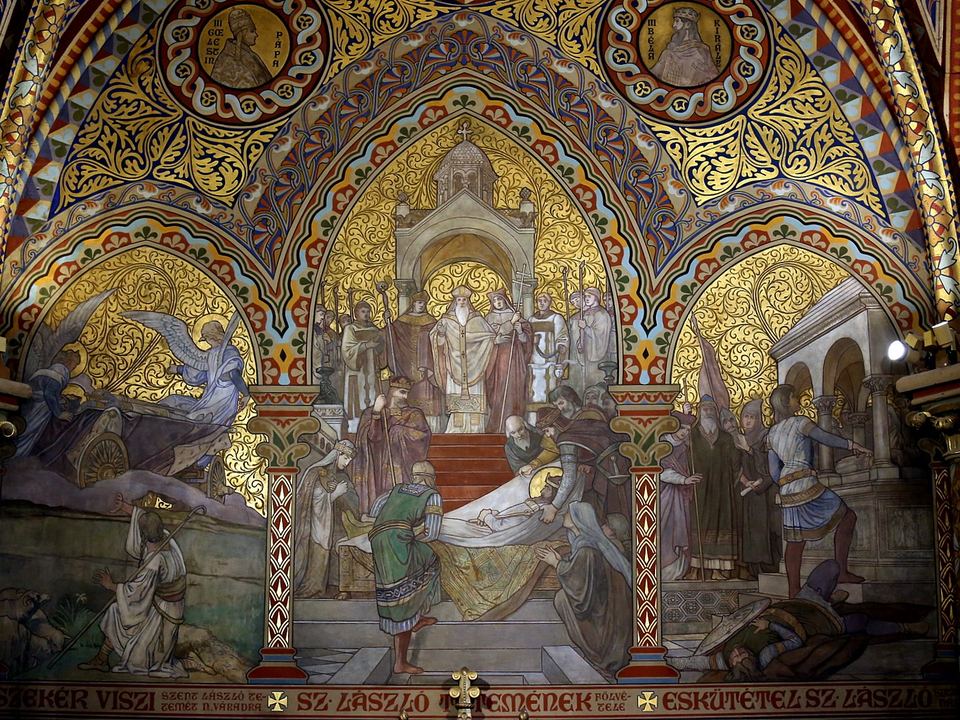
Almost every surface inside is painted, a 19th-century reinvention carried out during Schulek's restoration by two of Hungary's leading artists, Károly Lotz and Bertalan Székely. Their frescoes fill the walls and vaulted ceilings with Hungarian folk motifs and religious scenes, and both painters also designed the church's stained-glass windows.
The most striking single space is the Saint Ladislaus Chapel, where Lotz painted a fresco cycle telling the story of the sainted 11th-century king — including the dramatic scene of his funeral procession, rendered in the same gold-and-scarlet palette that covers the chapel's vaulted ceiling. Look up in the nave, too: Székely contributed seven frescoes of Hungary's first king, Saint Stephen, along with a set of windows depicting Hungarian saints.
Did you know?
During the 1686 siege that ended Ottoman rule of Buda, a wall inside the church — by then converted into a mosque — collapsed under cannon fire, revealing a statue of the Virgin Mary that had been bricked in and hidden since the Ottoman conquest 150 years earlier. According to local tradition, its sudden appearance in front of praying Ottoman soldiers was read as an omen, and the garrison defending that section of the castle gave up without a fight later that same day — a story still told as one of Buda's small miracles.
A less solemn detail: because Frigyes Schulek's 19th-century restoration reimagined large parts of the medieval structure rather than strictly reconstructing it, historians still debate how much of what visitors see today is genuinely medieval versus Schulek's own Gothic Revival invention.
Good to know
The church sits on Castle Hill, right next to Fisherman's Bastion, so the two are easy to combine in a single visit. It's still an active parish, which is why Sunday mornings are reserved for Mass and closed to sightseeing — plan a weekday or Sunday afternoon visit instead. As with any working place of worship, modest dress is appreciated, particularly covered shoulders.
Entry includes access to the nave and treasury; a separate, additional ticket lets you climb the Béla Tower for a close-up view of the tiled roof and a rooftop panorama over the Danube and Pest.