
Hungarian National Museum
- Museum
- Price: 3 200 Ft - 4 000 Ft
- Opening hours: 10:00 - 18:00 Tue-Sun, closed Mon
Book a guided tour of Budapest
Skip the line and see Budapest with a local guide.
History
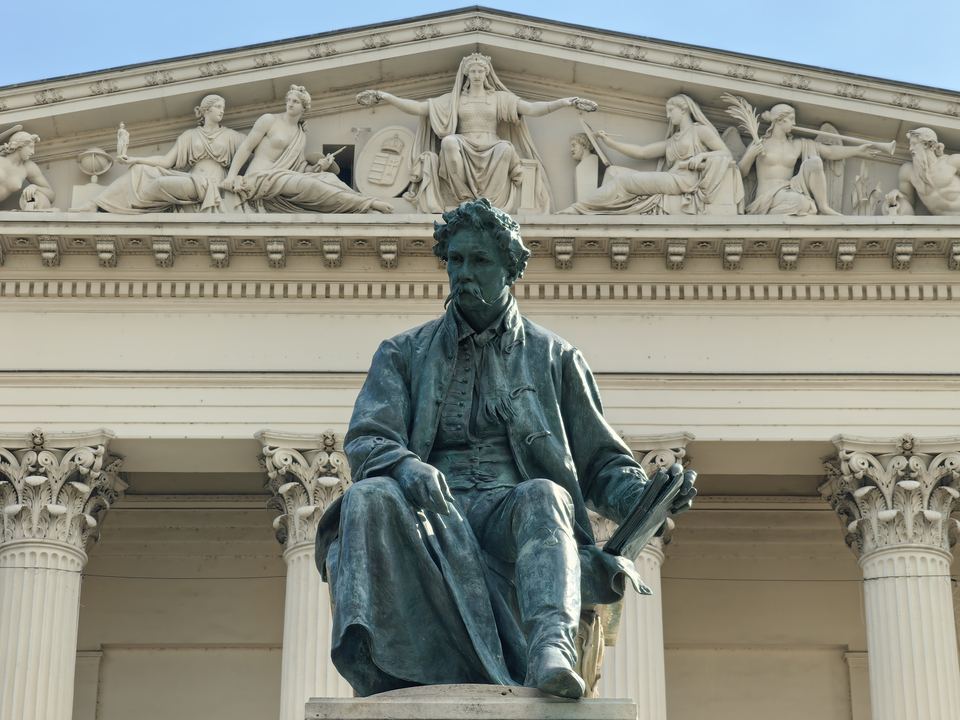
The museum began with a private gift: in 1802, Count Ferenc Széchényi persuaded Emperor Francis to accept his personal library and art collection, built up over a lifetime at the family estate in Nagycenk, as the founding core of a national museum. The institution spent its first decades without a proper home, its growing collections scattered across rented rooms, until architect Mihály Pollack designed a purpose-built neoclassical palace on Múzeum körút, raised between 1837 and 1847 — a temple-fronted building with ten colossal Corinthian columns and a broad flight of steps leading up to the portico.
Those steps had barely dried before they became a stage for history. During the Second World War the building took its own share of damage: an Allied air raid on 13 September 1944 set the roof structure alight, and further harm followed during the winter siege of Budapest. Most of the collection survived because staff had already moved the most valuable pieces into the basement and shelters beforehand; the worst postwar loss, ironically, came afterwards, from a fire started by careless Soviet soldiers in a storage area beneath the main staircase.
The birthplace of a revolution
On 15 March 1848, a crowd gathered on the museum's front steps to hear the demands that would ignite the Hungarian Revolution against Habsburg rule. Poet Sándor Petőfi is remembered as reciting his 'National Song' there that morning, its refrain — 'we vow, we vow, that we will slaves no longer be' — becoming the uprising's rallying cry, alongside the Twelve Points demanding a free press, an end to censorship, and self-government for Hungary. Historians note the day actually unfolded across several locations, including the Pilvax Café where the revolutionary youth first gathered, so the museum steps are best understood as where the moment is remembered rather than a single verified spot — but that's exactly where Hungary chose to remember it.
Every 15 March, a national holiday, the steps fill again with costumed re-enactors, flags, and cockades in the national colours, echoing the original scene. The museum leans into the association: its front garden and forecourt double as a public gathering space year-round, one of the few museum entrances in Budapest that functions as a civic square as much as a doorway.
Did you know?
Among the museum's treasures is the Hungarian Coronation Mantle, originally a bell-shaped chasuble that King Stephen I and Queen Gisela donated to a church in Székesfehérvár in 1031. Woven from Byzantine silk and covered almost entirely in gold-thread embroidery, it shows the royal couple flanking a cross, along with a portrait believed to be their son, Prince Emeric. Later altered into an open mantle, it went on to serve at Hungarian coronations for 885 years, right up to the country's last one, Charles IV, in 1916.
The collection also holds Roman-era mosaics and everyday objects excavated from within Hungary's own borders, the legacy of Pannonia, the Roman province that once covered the western half of the country, complete with its own governors, garrison towns, and villas along the Danube frontier.
Good to know
The museum keeps regular hours, open 10:00 to 18:00 Tuesday through Sunday and closed on Mondays, with standard tickets running roughly 3,200 to 4,000 forints depending on which temporary exhibitions are running alongside the permanent collection.
It sits on Múzeum körút, a short walk from Kálvin tér metro station, in a museum quarter that also includes the Hungarian Natural History Museum next door — easy to combine into one cultural afternoon. The building's own leafy front garden, dotted with statues of Hungarian historical figures, is open to the public and free to enter even without a museum ticket.