
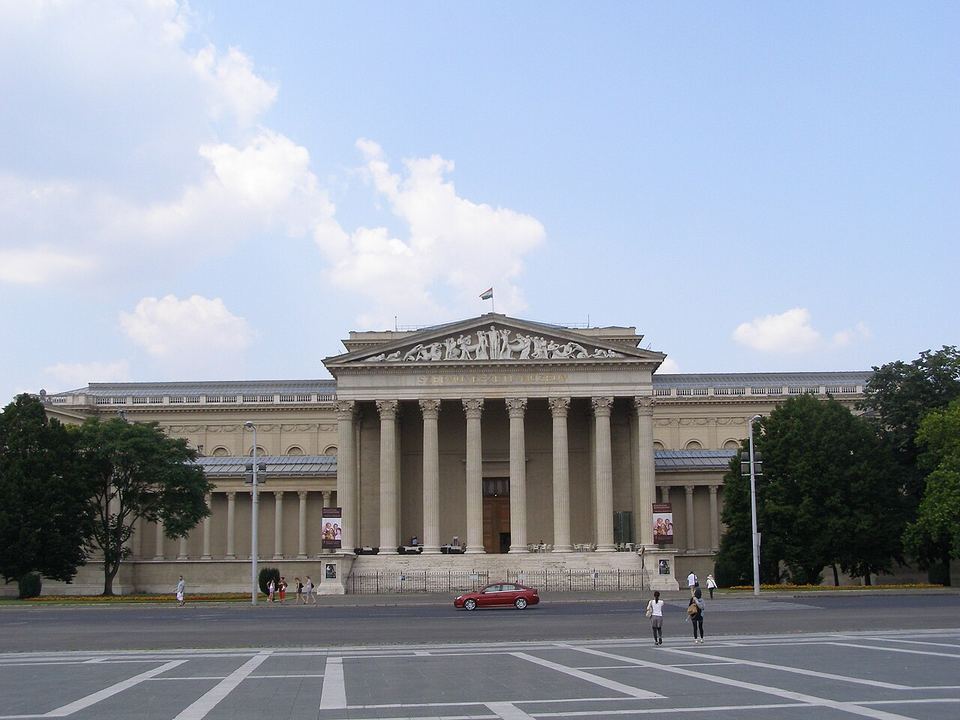
Museum of Fine Arts
- Art Museum & Gallery
- Price: 5 800 Ft - 6 800 Ft
- Opening hours: 10:00 - 18:00 Tue-Sun (extended to 20:00 second Fri of month), closed Mon
Book a guided tour of Budapest
Skip the line and see Budapest with a local guide.
History
The Museum of Fine Arts opened in 1906 as Hungary's dedicated home for foreign art, built between 1900 and 1906 to designs by Albert Schickedanz and Fülöp Herzog on the edge of the newly laid-out Heroes' Square, part of the wave of construction that marked Hungary's 1896 millennial celebrations. Its collection had a decisive head start: in 1870, the state bought the Esterházy family's private picture gallery, 637 Old Master paintings the princely dynasty had assembled over generations, giving the future museum a world-class core before it even had a building of its own.
That single acquisition brought in works by Raphael, Correggio, Tintoretto, Rubens, Van Dyck and Goya in one stroke, and later donations and purchases layered on top of it, from classical antiquities to Egyptian artefacts, to build the broad, encyclopaedic collection on show today.
The Old Masters and the Spanish collection
Thanks largely to the Esterházy holdings, the museum's Spanish collection ranks among the best outside Spain itself, mentioned in the same breath as the Louvre's and the Hermitage's. Its centrepiece is a group of seven paintings by El Greco, the largest gathering of his work anywhere outside Spain, alongside canvases by Velázquez and Goya that regularly draw loan requests from museums abroad.
At the heart of the building is the Renaissance Hall, a vast covered courtyard modelled on a 16th-century Italian palazzo, complete with arcaded galleries, balustrades and frescoes by Károly Lotz and Gyula Benczúr. Rather than paintings, it displays the museum's collection of Italian frescoes and a set of carved Venetian wellheads, turning the room itself into part of the exhibition.
Did you know?
The museum's Egyptian collection is one of the largest in Central and Eastern Europe, with around 3,500 objects gathered largely through a 1907 excavation at Sharuna and Gamhud in central Egypt, which brought back 25 wooden coffins along with mummies, sarcophagi and jewellery.
Four of those mummies remain on display today, alongside painted mummy portraits from Roman-era Egypt, a strikingly lifelike genre of funerary painting that art historians consider a direct ancestor of later portrait painting in Europe.
Good to know
Opening hours run 10:00 to 18:00 Tuesday to Sunday, closed Mondays, with the museum staying open until 20:00 on the second Friday of each month for a quieter evening visit. Standard tickets cost roughly 5,800 to 6,800 forints depending on which temporary exhibitions are on.
The museum faces the Millennium Column across Heroes' Square, next to the Museum of Ethnography and across the square from the Hall of Art (Műcsarnok), and combined tickets covering more than one of these are usually worth it for a full day around the square. City Park, with Vajdahunyad Castle and the Széchenyi thermal baths, is a short walk beyond.