
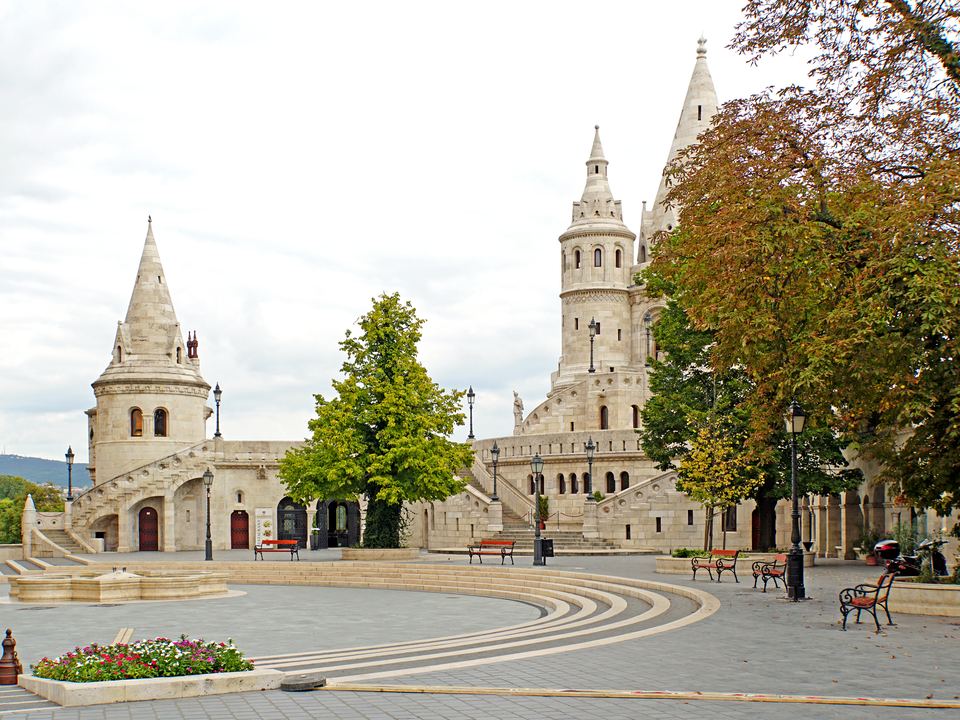
Fisherman's Bastion
- Viewpoint & Tower
- Historic Site
- Price: 0 Ft - 1 000 Ft
- Opening hours: Lower terraces open 24h; upper towers 09:00 - 19:00 (Apr-Oct, weather permitting)
History
Despite its fortress-like silhouette, the Fisherman's Bastion never defended anything. Architect Frigyes Schulek — fresh from restoring the neighbouring Matthias Church — designed it between 1895 and 1902 purely as an ornamental viewing terrace, part of Hungary's millennium celebrations marking a thousand years since the Magyar tribes settled the Carpathian Basin in 895. He built it over a stretch of the old castle walls once guarded, in genuinely dangerous times, by the guild of fishermen who lived in the riverside quarter below — which is where the name comes from.
The bastion suffered serious damage during the sieges of World War II, when fighting tore through the Castle District as German and Soviet forces battled for the city. Restoring the white limestone terraces, arcades and stairways to Schulek's original design took years and wasn't finished until 1953.
The Seven Towers
Seven conical towers rise along the bastion's arcaded walkway, one for each of the Magyar chieftains traditionally credited with leading the tribes into the Carpathian Basin. Schulek combined round Romanesque arches with pointed Gothic Revival details across the white stone, giving the whole structure the fairy-tale look of a 19th-century romantic vision rather than any genuine medieval fortress.
A bronze equestrian statue of King Stephen I, Hungary's first Christian monarch, stands in front of the bastion, unveiled in 1906. Sculptor Alajos Stróbl set the king facing the Danube on a pedestal carved with scenes from his life — a fitting neighbour for a monument built to celebrate a thousand years of Hungarian nationhood.
Did you know?
When the bastion was first being built in the 1890s, workers digging into the hillside uncovered medieval tombstones and the remains of a buried chapel — a reminder of just how much history was already stacked beneath this stretch of Castle Hill before Schulek ever broke ground.
The Fisherman's Bastion forms part of the Buda Castle Quarter, inscribed on the UNESCO World Heritage list in 1987, and its view over the Danube, Margaret Island and the Parliament building is often rated the best in the city — which is exactly why the terraces get crowded around sunrise and sunset. Come early and you'll mostly have the view to yourself.
Good to know
The lower terraces are free and open around the clock; only the closest upper viewpoints charge a small entry fee, roughly April to October, weather permitting. Before opening and after closing, or outside that season, the towers can be seen up close at no cost.
The bastion sits right next to Matthias Church, so the two combine easily into one visit to Castle Hill, and there's a restaurant on the terrace if you'd rather linger over the view than just pass through. Arrive early morning to beat the tour groups and catch the best light on the white stone.